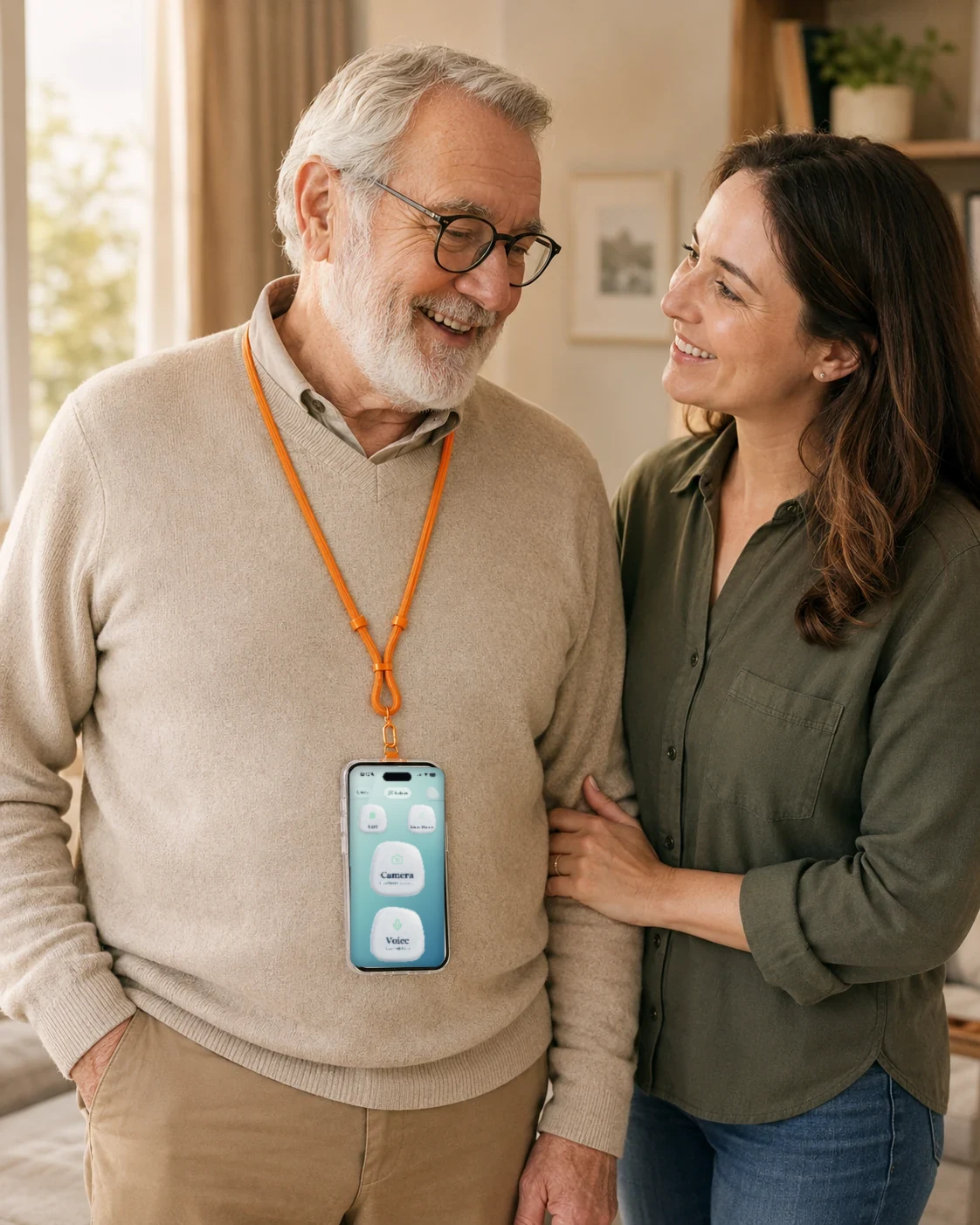
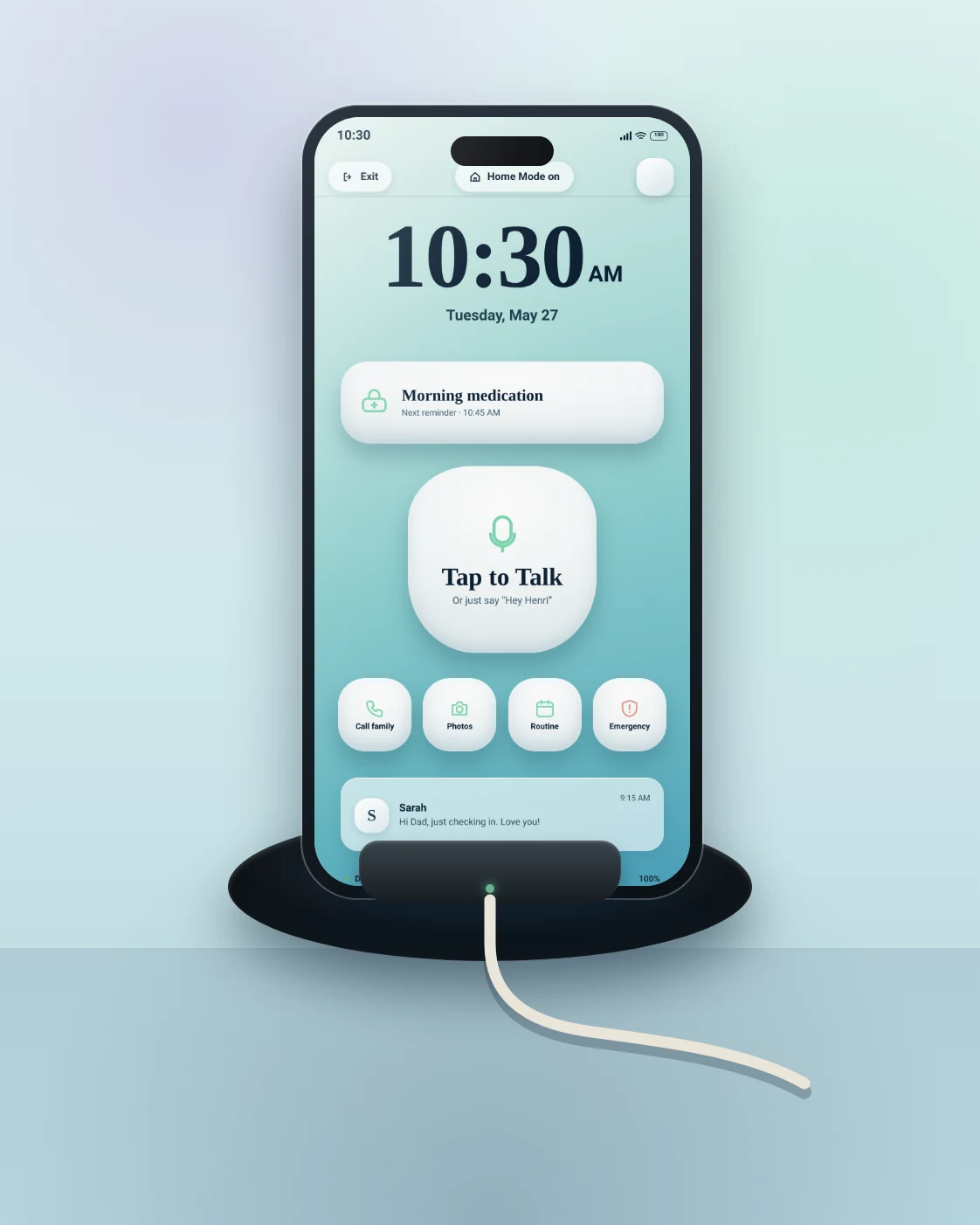
Henri gives an aging parent a simple way to talk, take photos, remember routines, and stay connected — while giving you meaningful visibility, without surveillance.
Henri is designed for families who are not ready for full-time care, but are past the point where “just call me if you need anything” feels safe enough.
Large buttons, simple flows, voice-first access, and a physical lanyard and home-dock habit that makes Henri part of the day — not another app to forget.
Daily summaries, check-ins, contact attempts, reminders, and pattern changes — written in plain language, not raw logs.
The same profile can later support facility views, escalation, and resident-priority workflows — home first, care teams next.
This is the habit that makes Henri work. Flip the switch — and watch the same phone change roles.
Henri rides on the body — two big circles, voice and photos, always within reach. The screen stays radically simple while the connected profile does the thinking underneath.
Tip: you can still grab and spin the phone in either mode.
Henri is not an app, a gadget, or a dashboard — it is all of them, orbiting one connected care profile. Hover the system to explore it.
Every interaction — a question asked, a photo taken, a reminder acknowledged, a check-in completed — feeds one profile that the whole circle of care can trust. Hover any part of the system to see its role.
Henri Sense is our intelligence layer — a category-first AI that understands each moment, a deterministic engine that runs the numbers, and humans who make every decision. Here is how we built it.
Henri doesn’t match keywords — every interaction is understood for meaning, then classified into one of four concern domains: Cognitive Health, Emotional & Mental Wellbeing, Health & Safety, Independence & Daily Living. “Is it Christmas yet?” in July and “What year is it?” land in the same place.
By design, the AI only understands and classifies. A separate deterministic engine does all the math — same history in, same score out. Reproducible, testable, auditable. No black-box arithmetic deciding what your family hears.
Sense learns what normal looks like for this person — not the average older adult. It spends weeks of ordinary days maturing the baseline before it trusts its own read, and a hard week is never allowed to quietly become the new normal.
The same question means different things at 3:00 PM and 3:00 AM. Events are weighed across rolling time windows — similar moments clustering close together raise the concern, while bounded severity keeps any single off moment in proportion.
Everything distils into one 0–100 HenriSense Score — Normal, Monitor, or Escalate — with the reasons and evidence attached. The AI never diagnoses. And validated urgent events go straight to people, bypassing the math entirely.
Why it matters: a single confused prompt never triggers an alert — and a bad week never becomes the new baseline. When Margaret’s orientation questions rise far above her own normal, the score moves, the reasons come attached, and her family hears about it gently, and early. Not alarming. Just informative.
Henri Sense learns this person’s everyday patterns and gently alerts families when something is genuinely different. It reads reminders, questions, photos and check-ins together — as context, across four domains of concern, in plain language.
Henri learns weeks of this person’s normal before interpreting change — and says so while learning.
Everything distils into a single 0–100 HenriSense Score: Normal, Monitor, or Escalate.
Every alert arrives with its reason and evidence — never raw logs, never a black box.
The same reason-coded signals can support staff dashboards and priority views.
Early-access families help shape Henri — and lock in founding-member pricing, priority onboarding, and a direct line to the team building it.